Merseyside
Updated 28 September 2026Newton-le-Willows
What’s On
Coming up in Newton-le-Willows
Soonest first. Check the linked source for details before travelling.
- SAT28NOV
Earlestown Christmas Light Switch On and Artisan Market
This weekEarlestown Market, Market Street
The Earlestown Artisan Market on Saturday 28 November 2026 is billed as the Christmas light switch-on. It runs from 11am to 4pm at Earlestown Market.
- Earlestown Artisan Market 2026 — Artisan Markets Northwest · retrieved 28 Sept 2026
- WED2DEC
Christmas Afternoon Jump Racing at Haydock Park
Haydock Park Racecourse, Newton-le-Willows
A midweek afternoon of National Hunt racing on Wednesday 2 December, listed among the racecourse's 2026 fixtures. Check the Jockey Club site for gates and ticket details nearer the day.
- Haydock Park 2026 Fixtures — The Jockey Club · retrieved 28 Sept 2026
- SUN20DEC
Earlestown Artisan Market
Earlestown Market, Market Street
The final announced artisan market of 2026 runs on Sunday 20 December from 11am to 4pm, with local makers, food and drink and live music in Earlestown.
- Earlestown Artisan Market 2026 — Artisan Markets Northwest · retrieved 28 Sept 2026
No checked upcoming events are listed here yet.
Places to explore in and around Newton-le-Willows
- Haydock Park RacecourseAttractions & days out
- Mesnes ParkParks & outdoors
Newton-le-Willows is a town in the St Helens borough of Merseyside, sitting between Wigan to the north and Warrington to the south, roughly halfway between Liverpool and Manchester. It is made up of two centres: the older Newton village with its High Street, and Earlestown, which grew around the railway and holds the market. The Sankey Viaduct, completed in 1830 for the Liverpool and Manchester Railway, is the town's best-known landmark, and Haydock Park Racecourse lies on its edge.
- Newton-le-Willows — Wikipedia · retrieved 28 Sept 2026
- Sankey 'Nine Arches' Viaduct — National Transport Trust · retrieved 28 Sept 2026
- Haydock Park Racecourse — The Jockey Club · retrieved 28 Sept 2026
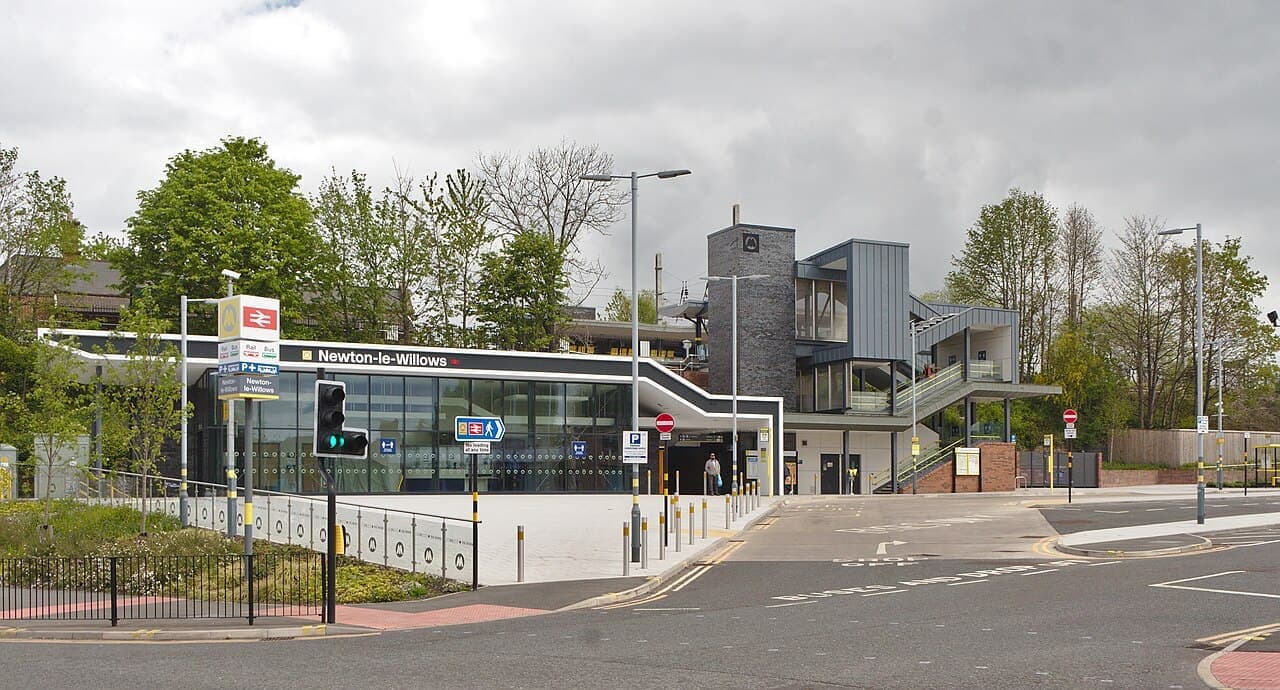
The town
About Newton-le-Willows
About 24,600 people live in the Newton-le-Willows built-up area, which takes in both the old village and Earlestown. The two centres are a short distance apart and each keeps its own character. Newton's High Street has St Peter's Church and a handful of pubs, while Earlestown's Market Square is the commercial heart, with independent shops and cafés along Market Street.
A retail market trades on Fridays from 9am to 3pm, with about 150 stalls on Haydock Street, and a flea and craft market runs on Saturdays from 9am to 2pm. A newer artisan market has been added on selected Sundays in 2026, with local makers, food stalls and live music. The former Vulcan Foundry site, closed in 2002, has been rebuilt as housing, although the old workers' cottages known as Vulcan Village survive at its southern corner.
Green space is a strength. Mesnes Park, a Green Flag park that opened in 1927, has bowling greens, tennis courts, a bandstand and woodland walks, and Sankey Valley Country Park follows the line of the old Sankey Canal through the town, giving walkers, anglers and cyclists a traffic-free route past the wildfowl and wetlands. Haydock Park Racecourse, on the southern edge of its neighbouring parkland, stages flat and jump racing through the year and non-racing events such as concerts. The town has two railway stations, Newton-le-Willows and Earlestown, with regular trains towards Liverpool, Manchester and Chester.
- Newton-le-Willows built-up area — City Population (ONS 2021 Census) · retrieved 28 Sept 2026
- Market day in Earlestown — Newton-le-Willows News · retrieved 28 Sept 2026
- Flea Market in Earlestown — Newton-le-Willows News · retrieved 28 Sept 2026
- Mesnes Park — Newton-le-Willows Heritage Trail · retrieved 28 Sept 2026
- Vulcan Foundry — Wikipedia · retrieved 28 Sept 2026
- Haydock Park Racecourse — The Jockey Club · retrieved 28 Sept 2026
Looking back
A short history
The name is generally traced to a "new town" in the ancient district of Makerfield, and Newton appears in the Domesday Book as Neweton. Before the Norman Conquest it was the head of a hundred, and the Banastre family held the barony from the Conquest until 1286. A chapel on the site of St Peter's Church served the township from the seventeenth century. The present church was rebuilt between 1892 and 1901 to designs by Walter Henry Brierley, who grew up in the town.
The Sankey Canal, described as the first canal of the Industrial Revolution, opened in 1757. The Liverpool and Manchester Railway brought a second wave of industry to the district. The railway opened in 1830, crossing the Sankey valley on George Stephenson's nine-arch viaduct. On opening day, 15 September 1830, the MP William Huskisson was struck by Rocket near Parkside and later died, in what is often described as the first fatal railway accident. The Vulcan Foundry was founded in 1832 as Charles Tayleur and Company. It built more than six thousand steam locomotives between 1833 and 1956.
Earlestown grew up around the railway junction and the wagon works established there in the 1850s. It was named in 1855 after Sir Hardman Earle, a director of the London and North Western Railway. Its Town Hall, designed by Thomas Beesley, opened in December 1893, and the Beatles played there on 30 November 1962. The Sankey Canal was closed in 1963. On 1 April 1974 the urban district became part of the new St Helens Metropolitan Borough in Merseyside. The Vulcan Foundry's works closed in 2002.
- Newton-le-Willows — Wikipedia · retrieved 28 Sept 2026
- Earlestown — Wikipedia · retrieved 28 Sept 2026
- Canal — Newton-le-Willows Heritage Trail · retrieved 28 Sept 2026
- William Huskisson — Wikipedia · retrieved 28 Sept 2026
- Earlestown Town Hall — Wikipedia · retrieved 28 Sept 2026
- Church of St Peter, Newton-le-Willows — Manchester Victorian Architects · retrieved 28 Sept 2026
- Vulcan Foundry — Wikipedia · retrieved 28 Sept 2026
- Sankey Canal — Wikipedia · retrieved 28 Sept 2026
Directory
Businesses and places in and around Newton-le-Willows
Loading places in Newton-le-Willows…
Listings from OpenStreetMap contributors (ODbL); food hygiene ratings from the Food Standards Agency (Open Government Licence). The finder above holds our own researched listings. Directory snapshot 9 October 2026.
Quick answers
Newton-le-Willows FAQs
When is Earlestown market?
The Friday retail market runs every Friday, 9am to 3pm, and the Saturday flea and craft market every Saturday, 9am to 2pm, both in Earlestown town centre on Haydock Street.
- Market day in Earlestown — Newton-le-Willows News · retrieved 28 Sept 2026
- Flea Market in Earlestown — Newton-le-Willows News · retrieved 28 Sept 2026
What is the Sankey Viaduct?
It is the nine-arch railway viaduct built by George Stephenson between 1828 and 1830 for the Liverpool and Manchester Railway. It is Grade I listed, still carries trains and is known locally as the Nine Arches.
- Sankey 'Nine Arches' Viaduct — National Transport Trust · retrieved 28 Sept 2026
- World's oldest railway viaduct gets repairs — Network Rail · retrieved 28 Sept 2026
Which railway stations serve Newton-le-Willows?
Newton-le-Willows station, opened in 1830 as Newton Bridge, and Earlestown station, opened on 17 September 1830, both lie on the Liverpool to Manchester line.
- Newton-le-Willows railway station — Wikipedia · retrieved 28 Sept 2026
- Earlestown railway station — Wikipedia · retrieved 28 Sept 2026
Where can I park in Earlestown?
The market listings say there is free parking within walking distance of Earlestown town centre, with free public toilets at the corner of Market Square.
- Market day in Earlestown — Newton-le-Willows News · retrieved 28 Sept 2026
- Flea Market in Earlestown — Newton-le-Willows News · retrieved 28 Sept 2026
Is Haydock Park racecourse in Newton-le-Willows?
The racecourse gives its address as Newton-le-Willows, Merseyside, WA12 0HQ. Wikipedia places it in parkland with Newton-le-Willows to the south.
- Haydock Park Racecourse — The Jockey Club · retrieved 28 Sept 2026
- Haydock Park Racecourse — Wikipedia · retrieved 28 Sept 2026
Why is the town linked to the first railway death?
William Huskisson MP was struck by Rocket at Parkside, near Newton-le-Willows, on 15 September 1830 during the opening of the Liverpool and Manchester Railway. He died later that day.
- William Huskisson — Wikipedia · retrieved 28 Sept 2026
For local businesses
Advertise to people who already live in Newton-le-Willows
Labelled placements on this page, kept clearly apart from the listings.
Open the advertiser portal