West Yorkshire
Updated 28 September 2026Leeds
What’s On
Coming up in Leeds
Soonest first. Check the linked source for details before travelling.
 ArtsIllustration
 Markets & foodIllustration
No checked upcoming events are listed here yet.
Places to explore in and around Leeds
- City Varieties Music HallArts, culture & venues
- Leeds Art GalleryAttractions & days out
Leeds is a city on the River Aire in West Yorkshire and the largest settlement in Yorkshire. It grew as a wool-trading and mill town and was granted city status in 1893. Visitors know it for its Victorian arcades and for Kirkgate Market, one of the largest indoor markets in Europe. The city has five universities, and its railway station is one of the busiest in the country.
- Leeds — Wikipedia · retrieved 28 Sept 2026
- Leeds Kirkgate Market — Visit Leeds · retrieved 28 Sept 2026
- Travelling to Leeds — Visit Leeds · retrieved 28 Sept 2026
The town
About Leeds
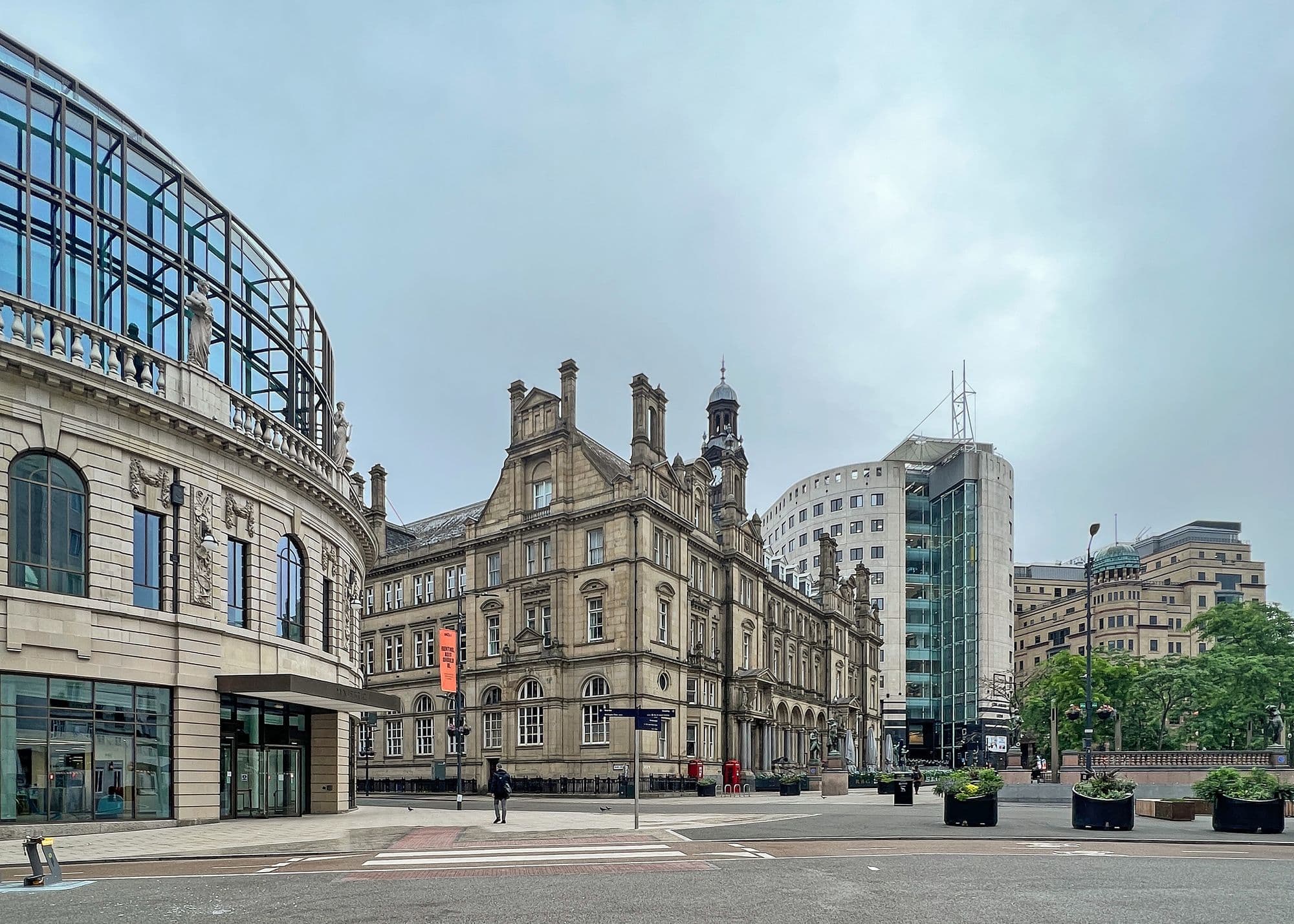
Leeds sits on the River Aire in the eastern foothills of the Pennines and is the largest settlement in Yorkshire. The city itself has about 536,000 residents, while the wider City of Leeds district had 812,000 at the 2021 census. Five universities give Leeds the fourth largest student population in the country. Its economy is described as the most diverse of the UK's main employment centres, with growth in corporate, legal and retail work.
Briggate, the main north–south shopping street, is pedestrianised, and nearby Queen Victoria Street is covered by a glass roof. Kirkgate Market has been at the centre of shopping in Leeds since 1857 and is one of the largest indoor markets in Europe, selling fresh food, flowers, fashion and hardware from Monday to Saturday. An Asian bazaar runs there every Wednesday morning, and a farmers market is held on Briggate on the first and third Sunday of the month. The market has also added an events space and now sells beer and wine. The Corn Exchange on Call Lane, in the Kirkgate area, is home to independent retailers and food traders.
Leeds Dock, beside the River Aire, mixes offices, shops, leisure and waterside flats, and is home to the Royal Armouries Museum. Millennium Square is a main focal point of the city centre. The M621 gives the city direct access to the M1 and M62, and three park-and-ride sites serve the centre. Leeds Bradford Airport has direct flights to more than 70 destinations, and the Flyer bus reaches the city centre in about 30 minutes.
- Leeds — Wikipedia · retrieved 28 Sept 2026
- Leeds Kirkgate Market — Visit Leeds · retrieved 28 Sept 2026
- Leeds Corn Exchange — Visit Leeds · retrieved 28 Sept 2026
- Leeds Dock — Wikipedia · retrieved 28 Sept 2026
- Travelling to Leeds — Visit Leeds · retrieved 28 Sept 2026
Looking back
A short history
The name Leeds is first recorded around 731, when Bede wrote of a district called Loidis. It is thought to be an older Celtic name, often read as the people living by a strongly flowing river, probably the Aire. By 1086 Leeds was a manor under the overlordship of Ilbert de Lacy, and in 1207 its townspeople received their first charter for a small borough close to the river crossing. The site of Leeds Minster has probably held a church since the seventh century; the present building was consecrated in 1841 and was then the largest new church built in England since St Paul's Cathedral.
Growth was slow through the Middle Ages, but by 1536 John Leland described Leeds as a market town that lived largely by cloth. Woollen cloth was first sold on the bridge over the Aire at the foot of Briggate, and the first White Cloth Hall opened in 1711. The Aire and Calder Navigation of 1699 and the Leeds and Liverpool Canal of 1816 widened trade, and the Leeds and Selby Railway opened in 1834. By 1840 the population had passed 150,000, with engineering in Hunslet and Holbeck and mills in Armley, Bramley and Kirkstall. The Corn Exchange, designed by Cuthbert Brodrick, opened to corn traders in 1864.
Leeds was granted city status in 1893. By 1914 its manufacturing had spread into printing, engineering, chemicals and clothing. Production of uniforms and munitions in the Second World War briefly reversed the decline of the 1930s, but by the 1970s the clothing industry was in irreversible decline. Finance, retail, call centres, offices and media have driven growth since. At the old Clarence Dock, derelict after decades of industrial decline, the Royal Armouries Museum opened in 1996 and began the area's redevelopment.
- History of Leeds — Wikipedia · retrieved 28 Sept 2026
- Leeds — Wikipedia · retrieved 28 Sept 2026
- History and Heritage — Leeds Minster · retrieved 28 Sept 2026
- Leeds Corn Exchange — Visit Leeds · retrieved 28 Sept 2026
- Leeds Dock — Wikipedia · retrieved 28 Sept 2026
Directory
Businesses and places in and around Leeds
Loading places in Leeds…
Listings from OpenStreetMap contributors (ODbL); food hygiene ratings from the Food Standards Agency (Open Government Licence). The finder above holds our own researched listings. Directory snapshot 9 October 2026.
Quick answers
Leeds FAQs
When is the market in Leeds?
Kirkgate Market trades Monday to Saturday, 8am–5.30pm, and is closed on Sundays. An Asian bazaar runs on Wednesday mornings, and a farmers market is held on Briggate on the first and third Sunday of each month.
- Leeds Kirkgate Market — Visit Leeds · retrieved 28 Sept 2026
How do I get to Leeds by train?
Leeds station is on New Station Street, just south of City Square in the city centre. LNER runs to London King's Cross every half hour, and there are direct trains to Manchester Piccadilly, Liverpool Lime Street, York, Newcastle, Edinburgh and Glasgow.
- Leeds railway station — Wikipedia · retrieved 28 Sept 2026
Is there park and ride in Leeds?
Yes. Three park-and-ride sites serve the city centre, at Elland Road, Temple Green and Stourton, with free parking and a bus into the centre. An adult return costs £5, or £3 at weekends and off-peak.
- Travelling to Leeds — Visit Leeds · retrieved 28 Sept 2026
What is Leeds known for?
Leeds grew on the woollen cloth trade, and later on flax, engineering and printing. It is also known for shopping, with several surviving Victorian arcades, and for a varied collection of museums.
- Leeds — Wikipedia · retrieved 28 Sept 2026
Where can I see art in the centre of Leeds?
Leeds Art Gallery on The Headrow shows modern and contemporary art from its collection alongside changing exhibitions. It is open Tuesday to Sunday and closed on Mondays.
- Leeds Art Gallery — Visit Leeds · retrieved 28 Sept 2026
For local businesses
Advertise to people who already live in Leeds
Labelled placements on this page, kept clearly apart from the listings.
Open the advertiser portal