Greater Manchester
Updated 28 September 2026Burnage
What’s On
Coming up in Burnage
Soonest first. Check the linked source for details before travelling.
No checked upcoming events are listed here yet.
Places to explore in and around Burnage
- Burnage Garden VillageAttractions & days out
- Cringle Playing FieldsParks & outdoors
Burnage is an area of south Manchester, four miles (6.4km) south of the city centre and east of Kingsway. It is mainly residential, with semi-detached houses built in the 1930s and 1940s. Burnage station on Fog Lane and Mauldeth Road station both sit on the Styal line, and the journey from Burnage to Manchester Piccadilly takes about 12 minutes. The district is the childhood home of Liam and Noel Gallagher of Oasis.
- Burnage — Wikipedia · retrieved 28 Sept 2026
- Burnage railway station — Wikipedia · retrieved 28 Sept 2026
The town
About Burnage
Burnage is a mainly residential area of Manchester, lying between Withington to the west, Levenshulme to the north, Heaton Chapel to the east and Didsbury and Heaton Mersey to the south. Most of its housing is semi-detached, built in the 1930s and 1940s. The ward covering the area had 18,506 usual residents at the 2021 Census, up from 17,663 in 2011, and the Office for National Statistics estimated 18,656 for mid-2024. At the 2021 Census the ward counted 6,479 Christians and 6,307 Muslims, so faith buildings of both kinds are part of everyday life here.
Education is local: Burnage has three primary schools, Acacias, Green End and St Bernard's RC, and one secondary, Burnage Academy for Boys, which became an academy in 2014. There are two Styal line stations, Burnage on Fog Lane and Mauldeth Road to the north, Metrolink is one stop south at East Didsbury, the number 25 bus runs through to Stockport and the Trafford Centre, and junction 5 of the M60 is close by.
Burnage Library on Burnage Lane hosts a calendar of community sessions through the Burnage Activity Hub. The Church of St Nicholas on Kingsway is a Grade II* listed church, and St Margaret's on Burnage Lane is a Grade II listed one.
Liam and Noel Gallagher of Oasis spent their childhood here and attended St Bernard's RC Primary School on Burnage Lane, and the writer Frances Hodgson Burnett, author of Little Lord Fauntleroy, spent most of her early childhood in Burnage.
- Burnage — Wikipedia · retrieved 28 Sept 2026
- Burnage ward — City Population (ONS 2021 and 2011 Census) · retrieved 28 Sept 2026
- About Us — Khanqah Naqshbandia Mujaddidia · retrieved 28 Sept 2026
- What's On — Burnage Activity Hub · retrieved 28 Sept 2026
- Church of St Nicholas, Burnage — Wikipedia · retrieved 28 Sept 2026
- St Margaret's Church, Burnage — Wikipedia · retrieved 28 Sept 2026
Looking back
A short history
The name Burnage is thought to come from "Brown Hedge", after the old brown stone walls that were common in the area in medieval times, and a survey of 1320 calls the district "Bronadge". In the Middle Ages it was common pasture and marsh land. Burnage had no manor of its own, and the land was shared between farmers from the manors of Withington and Heaton Norris. By 1655 Burnage had become a township. The Egerton family were major landowners here, and in 1894 George Bernard Shaw described Burnage as the prettiest village in Manchester. Hand weaving was an established cottage industry, and parts of Burnage Lane still have original weavers' cottages.
The early twentieth century brought planned housing and industry. Burnage became part of the County Borough of Manchester in 1904. In 1906 plans were made for a garden suburb, which became Burnage Garden Village, built between 1906 and 1910 by Manchester Tenants Ltd. In the same year Hans Renold established an engineering works at Burnage to make roller chain, and it closed during the late 1980s. The site now has a Tesco supermarket and a development of flats and retail units.
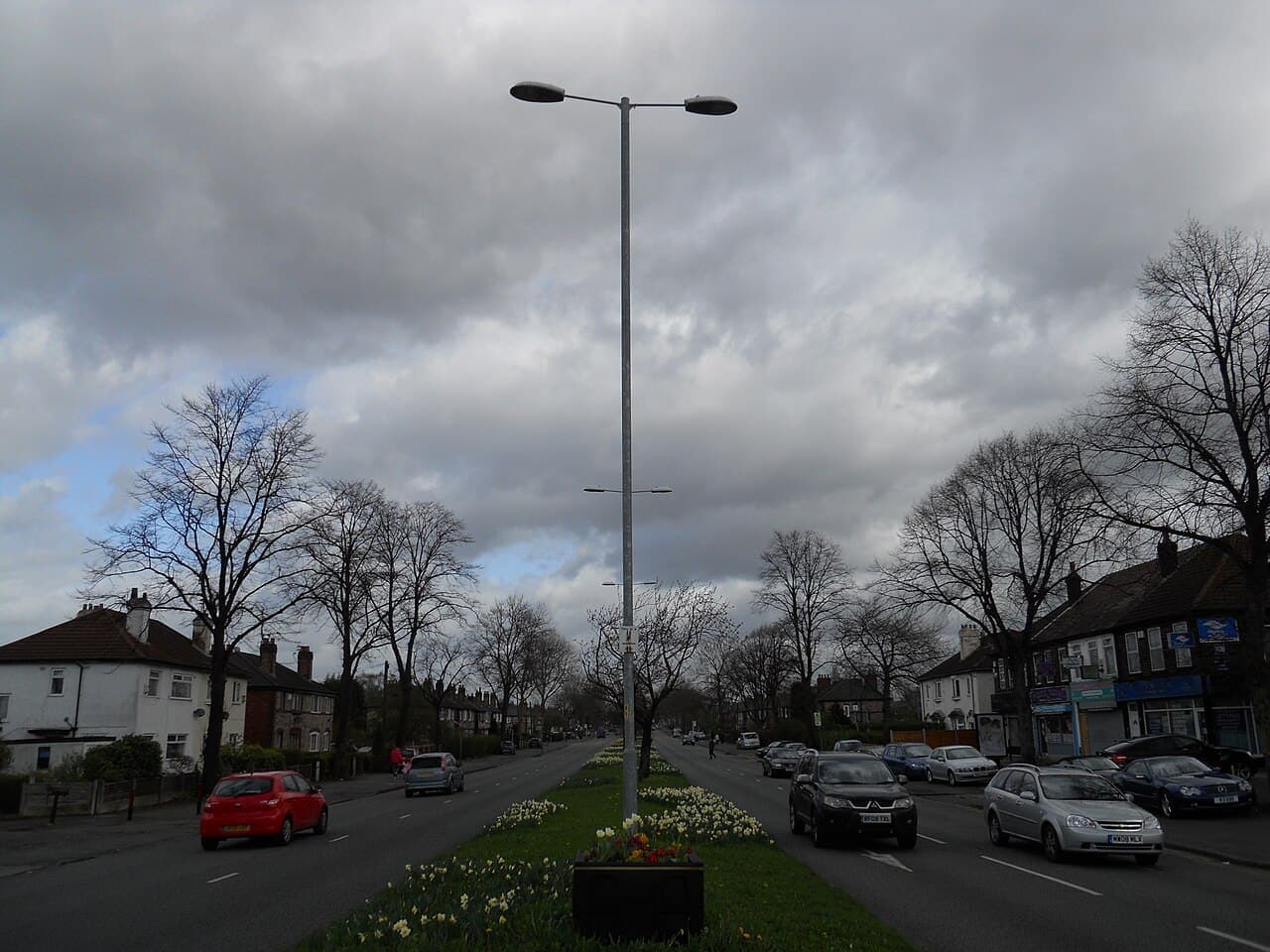
Burnage railway station opened in 1910. On 28 April 1910 the French pilot Louis Paulhan landed his biplane near Burnage, Withington and Didsbury to complete the first powered flight from London to Manchester, and two special trains were chartered to Burnage station to carry spectators to the landing. Construction of Kingsway, the A34, began in 1928. It was named after King George V and was laid out with a tram track along its central reservation, and Manchester City Council built a large housing estate along its route.
St Margaret's on Burnage Lane was built in phases between 1874 and 1926 to designs by Paley and Austin. The Church of St Nicholas on Kingsway was built in 1930 to 1932 by N. F. Cachemaille-Day and enlarged in 1964.
- Burnage — Wikipedia · retrieved 28 Sept 2026
- Burnage railway station — Wikipedia · retrieved 28 Sept 2026
- Church of St Nicholas, Burnage — Wikipedia · retrieved 28 Sept 2026
- St Margaret's Church, Burnage — Wikipedia · retrieved 28 Sept 2026
- Burnage Garden Village — Architects of Greater Manchester · retrieved 28 Sept 2026
Directory
Businesses and places in and around Burnage
Loading places in Burnage…
Listings from OpenStreetMap contributors (ODbL); food hygiene ratings from the Food Standards Agency (Open Government Licence). The finder above holds our own researched listings. Directory snapshot 6 October 2026.
Quick answers
Burnage FAQs
How many people live in Burnage?
The 2021 Census counted 18,506 usual residents in Burnage electoral ward, up from 17,663 in 2011, and the Office for National Statistics estimated 18,656 for mid-2024.
- Burnage ward — City Population (ONS 2021 and 2011 Census) · retrieved 28 Sept 2026
- Burnage (ward) — Wikipedia · retrieved 28 Sept 2026
How do I get to Burnage by train?
Burnage station is on the Styal line, between Manchester Piccadilly and Manchester Airport, and opened in 1910.
- Burnage railway station — Wikipedia · retrieved 28 Sept 2026
- Burnage — Wikipedia · retrieved 28 Sept 2026
Did Oasis really grow up in Burnage?
Yes. Liam and Noel Gallagher of Oasis spent their childhood in Burnage, and they attended St Bernard's RC Primary School on Burnage Lane.
- Burnage — Wikipedia · retrieved 28 Sept 2026
What is Burnage Garden Village?
It is a garden suburb off the western side of Burnage Lane, built between 1906 and 1910 for Manchester Tenants Limited.
- Garden Village — Burnage: a place called home · retrieved 28 Sept 2026
- Burnage Garden Village — Architects of Greater Manchester · retrieved 28 Sept 2026
What happened to the Renold works in Burnage?
Hans Renold established an engineering works at Burnage from 1906 to manufacture roller chain. The factory closed during the late 1980s, the site lay abandoned for several years, and it now holds a Tesco supermarket and a development of flats and retail units.
- Burnage — Wikipedia · retrieved 28 Sept 2026
Why did a plane land in Burnage in 1910?
On 28 April 1910 the French pilot Louis Paulhan landed his Farman biplane in Barcicroft Fields, on the borders of Withington, Burnage and Didsbury, completing the first powered flight from London to Manchester. He won a £10,000 prize offered by the Daily Mail. A blue plaque on Paulhan Road records the achievement.
- Burnage — Wikipedia · retrieved 28 Sept 2026
For local businesses
Advertise to people who already live in Burnage
Labelled placements on this page, kept clearly apart from the listings.
Open the advertiser portal